
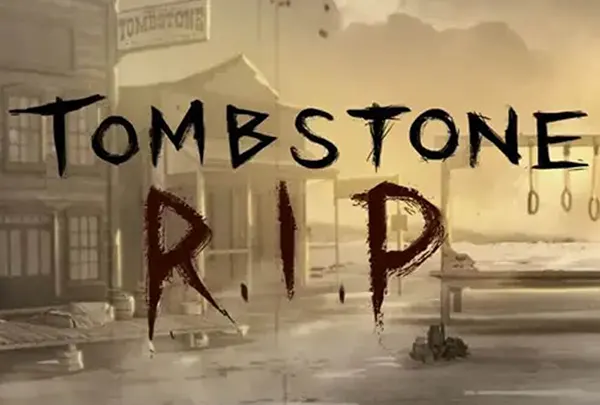
Tombstone RIP: the strongest features explained — what matters more, x3 or a line multiplier?
Tombstone RIP by NoLimit City is one of those slots where small details in the mechanics decide whether a spin is forgettable or life-changing. As of 2025, it’s widely known for its extreme volatility, a 2-3-3-3-1 reel layout (108 ways by default), and a maximum win advertised at 300,000x. The confusing part for many players is not the theme or even the brutality of the variance — it’s understanding what actually drives the biggest payouts: the x3 Feature, or multipliers that sit on the winning line (or effectively apply to the entire win).
Core mechanics that create “real” win potential in Tombstone RIP
The foundation is the unusual reel shape: 2-3-3-3-1. This matters because it naturally limits how often full combinations appear while still allowing the game to “open up” when split mechanics kick in. In practical terms, you start with 108 ways to win, but the xSplit mechanic can increase the amount of symbol positions in a way that boosts hit opportunities and, more importantly, the size of connected clusters in ways-to-win logic. When players talk about Tombstone RIP feeling inconsistent, a big part of it is that the layout and xSplit can swing from dead spins to suddenly crowded reels.
Another major building block is how Wilds behave. This title is not about a single Wild type; it stacks several Wild concepts: xNudge Multiplier Wilds, split Wild behaviour, and multiplier effects that can attach to outcomes. The key is that the game can combine “more symbols on screen” with “a multiplier that actually matters”, which is why it can reach the advertised 300,000x cap. Many slots have multipliers, but not many allow the same spin to escalate symbol coverage and multiplier impact in a layered way.
Then there’s the controversial filter mechanic often referred to as xRIP. The simplest way to describe it: it can remove low-value wins, meaning a spin that would normally pay a small amount may pay nothing. Some players like this because it reduces the noise of tiny returns; others dislike it because it increases the feeling of drought and stretches bankrolls. Either way, it changes how you should judge “value” in a session: not by hit rate alone, but by how often wins actually clear meaningful thresholds.
Why multipliers in this slot behave differently from “normal” multiplier games
In many slots, a multiplier is either a fixed number for a bonus round, or a simple wild multiplier that affects only one part of a payline. Tombstone RIP is more complex because multipliers can be tied to Wild behaviour and can escalate during free spins. This means you’re not only asking “did I get a multiplier?” — you’re asking “did I get it at the moment when symbol coverage is at its peak?” That timing is the difference between a solid win and a record-level payout.
The free spins modes are designed to push that timing problem to the extreme. In Hang ’Em High Free Spins, the win multiplier increases as Wilds land. That sounds straightforward until you realise that the bonus can still be unproductive if the reels don’t expand into meaningful symbol connections. In Boothill Free Spins, the game can apply large random multipliers (commonly cited up to x999) to selected premium symbols. This can create explosive wins, but it’s not guaranteed — the bonus can also deliver multipliers on symbols that never connect properly.
So, when people compare “x3 versus line multiplier”, they often oversimplify. In this slot, a multiplier’s true value depends on how it aligns with reel state (split expansions, Wild coverage) and whether it lands in base play or during a bonus escalation. That’s why the same x3 can feel useless in one spin and decisive in another.
The x3 Feature: what it really does, and when it’s worth more than line multipliers
The x3 Feature is often misunderstood as “a direct win tripler”. In reality, players should treat it as a volatility lever. When x3 is active, you’re trading some frequency and comfort for the possibility that a rare connecting outcome becomes genuinely meaningful. If the game already relies on occasional high spikes, a flat x3 can be a serious boost in the right circumstances — but only if those circumstances actually happen in your session.
Where x3 tends to matter most is in spins where the slot already delivers strong structure: expanded symbol presence due to splits, plus a Wild placement that helps connect premium symbols. In those situations, x3 is not “nice to have” — it can be the difference between a win that feels like a recovery and a win that changes the balance. If a spin is already good, x3 makes it great. If a spin is average, x3 often still leaves it average.
The practical downside is that x3 doesn’t solve the core problem of the game: you still need the right patterns. Tombstone RIP is notorious for long, cold stretches. If you enable or chase x3 expecting it to carry the session on its own, it can feel like you’re just paying for extra risk. The smart way to think about x3 is not “will it give me wins”, but “will it amplify the specific win type I’m actually hunting in this slot.”
How to judge x3 value spin-by-spin (a player method)
A useful approach is to score spins by structure before you think about multiplier size. Ask: did xSplit meaningfully expand symbol presence, or did it create a messy screen with no connections? Did a Wild appear in a place that links premium symbols, or did it land in isolation? If the answer is “no structure”, then x3 doesn’t matter — it’s multiplying something that never had serious value.
Next, look at whether the spin had “multi-layer potential”. In Tombstone RIP, the best outcomes tend to come from the combination of symbol expansion and multiplier effects, not from either element alone. If you have expansion but no meaningful multiplier, the win can still be capped. If you have a multiplier but weak symbol coverage, you often get a disappointing result. x3 is strongest when it sits on top of a spin that already has both ingredients forming.
Finally, understand that x3 is most useful for players who accept the slot’s brutal identity. If you’re running small stakes and hoping for steady returns, x3 can feel like it adds stress without giving enough back. If you’re taking calculated shots at huge peaks, x3 becomes one of the few “simple” boosts that can turn a rare high-quality hit into a headline win.

Line multipliers: why they often beat x3 in the biggest wins
When players talk about “line multipliers” in Tombstone RIP, they’re usually describing multiplier effects that apply directly to the winning result created by Wilds and bonus mechanics. The reason these often outperform x3 is that they can scale far beyond x3 — sometimes dramatically. A flat x3 is predictable. A multiplier tied to Wild escalation or bonus events is not, and that unpredictability is where record wins are born.
In Hang ’Em High Free Spins, multipliers can increase as Wilds land during the feature. This creates a compounding effect: the more the bonus “behaves”, the stronger it becomes. In Boothill Free Spins, the potential gets even sharper because premium symbols can receive very high random multipliers. If those symbols connect in a strong screen state, the multiplier impact can dwarf what x3 could ever do.
That’s why many experienced players treat x3 as a helpful add-on, but see the real “endgame” as building the kind of spin where the slot’s own multiplier engine switches fully on. It’s not just “more multiplier”; it’s multiplier arriving at the same moment as maximum symbol connection. That intersection is what pushes wins into five figures of x value rather than four.
So what matters more in practice: x3 or line multipliers?
If your goal is maximum upside, line multipliers (especially in free spins) are the bigger driver. They can scale well beyond x3, and they’re designed to interact with the game’s strongest symbol-expansion behaviour. In other words, they’re the multipliers the game is truly built around.
If your goal is making strong base hits feel more meaningful, x3 can be valuable — but it’s not the “main character”. It improves the payoff of the rare good base spin, and it can help you turn a decent bonus result into something you actually feel. Just don’t expect it to change the nature of the slot; it won’t turn Tombstone RIP into a smoother ride.
The most honest answer is that the best wins often come when both ideas overlap: a strong screen state plus a serious multiplier effect, with x3 acting as an extra layer. But if you’re forced to choose which one truly matters for the biggest outcomes, the slot’s escalating multiplier behaviour — the kind that can stack and surge in free spins — is the stronger engine.