
Mahjong Master 2: What Changed in MannaPlay’s Asian Slot Sequel in 2026
Mahjong Master 2 arrived on 5 June 2026 as a direct follow-up to MannaPlay’s Mahjong Master, released only several months earlier on 28 October 2025. Rather than simply changing the artwork and retaining the same mathematics, MannaPlay rebuilt several important parts of the game. The sequel expands the playing area from five reels and four rows to six reels and six rows, raises the number of winning combinations from 1,024 to 46,656 ways, changes how the bonus round is activated and introduces golden symbols that can turn into Wilds after forming a win. At the same time, the studio has retained the cascade-based structure and the recognisable mahjong theme, making Mahjong Master 2 familiar in appearance while noticeably different in the way individual rounds develop.
How Mahjong Master 2 Changes the Original Game Format
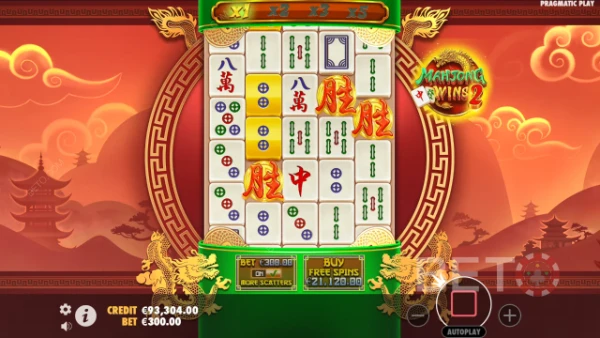
The most immediate difference is the size of the reel area. The first Mahjong Master uses a 5×4 arrangement, giving players 20 visible positions before a cascade begins. Mahjong Master 2 increases this to a 6×6 layout with 36 positions. That is not merely a visual enlargement. More symbols can appear during each paid round, more positions are involved when winning groups disappear and more replacements can enter during consecutive cascades. The result is a busier screen and a game flow in which a single initial win can produce a longer sequence of symbol movements than in the 2025 release.
The number of ways to win has increased even more substantially. Mahjong Master is officially listed with 1,024 ways, whereas Mahjong Master 2 offers 46,656. In practical terms, the sequel gives symbols many more possible positional combinations across the enlarged grid. Players therefore do not need to follow conventional fixed paylines visually. Instead, attention shifts towards matching symbols across the required adjacent reels and watching how the grid changes when successful combinations are removed. This makes the 2026 game easier to read as a cascading slot rather than a traditional line-based machine, despite the much larger number of possible winning arrangements.
MannaPlay has retained cascades as the central mechanism connecting both titles. After a qualifying combination appears, the relevant symbols are removed and new ones can occupy the vacant positions, creating an opportunity for another result within the same sequence. The original Mahjong Master already used this approach and added a score multiplier as cascades progressed. Mahjong Master 2 keeps the focus on repeat drops but changes what can happen inside them. Its official description specifically highlights more frequent chain drops, signalling that consecutive symbol removal is not a secondary extra but one of the main features around which the sequel has been designed.
Why the 6×6 Grid Makes the Sequel Feel Different
A 6×6 arrangement changes the rhythm even before any bonus feature is triggered. With 36 symbols visible at once, each round contains more information than the original 5×4 format. Wins can clear several areas of the screen, replacements have more spaces to occupy and subsequent drops can alter a substantial part of the layout. It creates a stronger sense of progression within a single paid round: the screen does not simply settle after the first calculation, because a successful combination may be followed by one or several further changes before play finally moves on.
The increase from 1,024 to 46,656 ways is particularly significant because the reel dimensions and the win system have been expanded together. A larger grid alone would not necessarily transform a sequel, but here it is combined with far more possible combinations. That makes Mahjong Master 2 structurally more ambitious than its predecessor while still keeping the basic action understandable. Players are not required to calculate thousands of combinations themselves. The game handles that automatically, while the player mainly follows successful groups, cascading replacements and any special symbols produced during the sequence.
This approach also suits the mahjong-inspired presentation. Traditional mahjong is not being reproduced as a table game with authentic hands, turns and scoring rules; the theme is used within a slot format. The dense arrangement of tile-like symbols makes greater visual sense on the 6×6 grid because the screen resembles a larger collection of mahjong pieces. The sequel therefore strengthens the connection between its theme and its mechanics without pretending to simulate conventional mahjong. It remains a chance-based casino slot, with outcomes determined by its game mathematics rather than by the strategic decisions associated with the original Asian game.
Free Games, Hu Scatters and Golden Wild Transformations
The bonus-entry requirement has changed between the two releases. In Mahjong Master, three or more Scatter symbols activate the Free Game feature. Mahjong Master 2 raises that threshold: five or more Scatters are required to trigger Free Games. The difference needs to be considered alongside the enlarged reel area, since the sequel displays considerably more symbol positions. Requiring additional Scatters therefore fits the redesigned 6×6 structure rather than functioning as an isolated rule change. The familiar “Hu” idea remains part of the series, preserving a clear link with the original title and its mahjong imagery.
Free Games can also continue through additional Scatter appearances. MannaPlay states that Scatters landing during the feature award extra free games, giving the bonus sequence a possibility of lasting beyond its initial allocation. This creates an important second objective once the feature has started. Ordinary combinations and cascades still matter, but further Scatters can extend the round. The studio does not present the sequel simply as a larger copy of the first game; retriggering is explicitly included among the 2026 title’s core rules and becomes part of the way longer bonus sequences can develop.
The other major addition is the golden-symbol mechanism. When golden regular symbols contribute to a winning combination, they subsequently become Wild symbols. This means a successful cascade can alter not only the empty spaces created by removed symbols but also the function of certain surviving positions. Wilds generally provide greater flexibility in forming combinations because they can substitute within eligible wins, so a golden symbol that changes state can influence what happens during the following drop. It gives successful chains a visible sense of development rather than resetting every part of the grid after each individual win.
How the New Features Affect the Flow of a Round
The golden-symbol rule is especially relevant in a cascade game because its value is connected to what happens next. A normal winning symbol performs its role and is removed as part of the calculation, but a qualifying golden symbol can leave behind a more useful Wild state. This creates a straightforward sequence that players can follow: a winning group appears, the cascade is resolved, designated golden pieces change and the altered grid can then contribute to subsequent combinations. The mechanic adds another layer to the chain reaction without requiring complicated decisions or a lengthy set of instructions.
Free Games build on the same principle of continuity. Instead of treating the bonus as an entirely separate type of game, Mahjong Master 2 keeps the familiar grid, cascades and special-symbol logic at the centre of play. The possibility of gaining additional free rounds from Scatters means the feature can extend naturally when the required symbols appear. There is no need to assume that a bonus round guarantees a particular return, however. Retriggers, cascades and Wild conversions remain dependent on the results produced during play, and none of these mechanics changes the random nature of individual outcomes.
The changes also make the sequel less dependent on a single headline feature. Its identity comes from several mechanics working together: the enlarged 6×6 area provides room for more combinations, 46,656 ways broaden the possible winning patterns, cascades repeatedly refresh the grid, Scatters provide access to and extensions of Free Games, and golden winning symbols can become Wilds. None of these elements is unusually difficult to understand on its own. Their importance comes from how they interact, giving the 2026 release more moving parts than Mahjong Master while retaining a relatively accessible set of basic rules.
RTP and the Practical Differences Between Mahjong Master and Its Sequel
One specification moves in the opposite direction to the larger grid and expanded win system: the published RTP. MannaPlay lists Mahjong Master at 97.85%, while Mahjong Master 2 has an RTP of 96.91%. That is a reduction of 0.94 percentage points. RTP is a theoretical long-term percentage calculated across a very large number of rounds under the game’s defined rules; it is not a prediction of what one person will receive during a session. A short run can finish well above or below the stated figure, so the difference between the two titles should be treated as a mathematical specification rather than an expected session result.
The comparison is still useful because it shows that a sequel with more ways to win does not automatically have a higher theoretical return. Mahjong Master 2 offers 46,656 ways compared with 1,024 in the original, yet its published RTP is lower. The number of ways describes how combinations can form across the reels, whereas RTP concerns the theoretical proportion returned over long-term play. These figures measure different aspects of a slot and should not be read as substitutes for one another. More possible winning patterns can change frequency and presentation without telling players how much a particular session will return.
MannaPlay’s own records also place the two games very close together historically. Mahjong Master launched on 28 October 2025 and Mahjong Master 2 followed on 5 June 2026, leaving a gap of a little over seven months. The short interval helps explain why so much of the first title’s identity remains recognisable. The sequel does not abandon cascading reels, mahjong imagery or the use of Hu-related bonus symbolism. Instead, it takes the original framework and enlarges it, using a denser grid and additional transformation mechanics to distinguish the second release.
Which Changes Matter Most to Players in 2026?
For someone familiar with the first Mahjong Master, the grid expansion is likely to be the clearest change from the opening round. Moving from 20 visible positions to 36 makes the sequel look and behave more densely, while the jump from 1,024 to 46,656 ways changes the scale of the underlying combination system. The golden-to-Wild transformation is the most notable new feature because it gives successful cascades a lasting effect on parts of the grid. Together, these changes make Mahjong Master 2 feel like a genuine mechanical revision rather than the same slot with a new visual treatment.
The altered bonus rules are equally important when comparing the titles directly. Three Scatters are enough to enter the feature in Mahjong Master, while its successor requires at least five. Mahjong Master 2 then allows Scatters within Free Games to award further rounds. The larger screen should be kept in mind when reading those conditions, as direct comparisons between three symbols on a 5×4 grid and five on a 6×6 grid can otherwise be misleading. What matters is that MannaPlay changed both the available space and the trigger requirement as part of the redesign.
As of 2026, the clearest picture of Mahjong Master 2 is therefore one of expansion combined with selective rule changes. It has a larger 6×6 layout, 46,656 ways to win, cascade sequences, a five-Scatter Free Games trigger, bonus extensions through further Scatters and golden winning symbols that can convert into Wilds. Its RTP of 96.91% is lower than the original game’s 97.85%, so the sequel should not be described as universally more favourable simply because it contains more combinations and features. MannaPlay has made it broader and more active mechanically while retaining enough of the 2025 release for the connection between the two games to remain obvious.