

Emperor Caishen (Pragmatic Play): what the Wild really triggers, and how to read “243 ways”
Emperor Caishen is a 5-reel, 3-row slot built around 243 ways to win, with a Wild that does two different jobs: it substitutes to complete wins, and it can randomly trigger a separate Jackpot Bonus Game. If you only look at the animations, it’s easy to overestimate what the Wild “adds” to your payout; if you read the payways correctly, you’ll see when it actually improves your result and when it’s simply visual noise. This guide focuses on the real mechanics players meet in 2026: how “243 ways” is counted, what the Wild actually does, and how to interpret wins without guesswork.
What “243 ways” means in Emperor Caishen (and what it doesn’t)
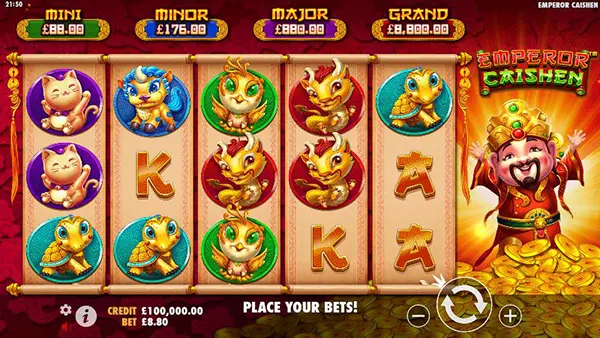
“243 ways” is the number of possible reel-to-reel routes when each of the five reels has three visible positions: 3×3×3×3×3 = 243. In practice, you don’t select paylines. A win happens when the same symbol lands on adjacent reels starting from the leftmost reel, and it can be on any row each time. That’s why you may see a symbol connect along a zig-zag path you never chose—because the game checks all eligible routes automatically.
A common misunderstanding is thinking 243 ways equals “243 paylines that can all pay at once”. It doesn’t work like that. For a single spin, the game checks each symbol and counts how many valid left-to-right combinations exist for it. What matters is whether the chain starts on reel 1, how many adjacent reels it reaches, and how many matching symbols appear on each reel within that chain.
To read a win screen properly, focus on three things: (1) the chain must start from reel 1, (2) it must be adjacent left-to-right (no skipping reels), and (3) duplicates on the middle reels increase the number of valid routes. You’ll often get “busy” screens where many icons match, but the actual paid result still depends on the paytable value of that symbol and the evaluated combination.
A quick, realistic example of payways counting
Imagine you land one Dragon on reel 1, two Dragons on reel 2, and one Dragon on reel 3. That creates two possible routes for a 3-of-a-kind because the reel-1 Dragon can connect to either Dragon on reel 2, and then to the single Dragon on reel 3. The game is effectively counting how many distinct connections exist, not rewarding you for “how nice it looks” on screen.
Now extend it: one Dragon on reel 1, two on reel 2, three on reel 3, one on reel 4, and one on reel 5. The number of routes becomes 1×2×3×1×1 = 6 possible ways to connect a 5-of-a-kind chain. This is exactly why payways slots can produce noticeable wins without needing a special line pattern—duplicates multiply routes.
The practical takeaway is simple: duplicates on early reels matter most, especially reel 1 and reel 2. Duplicates later on the right can look impressive, but they do not create a win unless reel 1 starts the chain. If you remember that one rule, you’ll instantly avoid the most common “it should have paid” frustration.
What the Wild really does: two separate mechanics
In Emperor Caishen, the Wild is a gold ingot symbol and it typically appears on reels 2, 3, and 4. Its first role is standard substitution: it can replace other symbols to complete left-to-right chains. If you are missing a symbol on reel 3, a Wild there can keep the chain alive and turn a near-miss into a paid hit.
The second role is the feature most players talk about: when a Wild lands, it can randomly trigger the Jackpot Bonus Game from the base game. This trigger is not based on collecting three scatters or “charging” a meter; it’s a random event linked to Wild appearances. That means the Wild has a visible value (substitution on the current spin) and a separate hidden value (a chance to start a bonus round).
Expectation management matters. A Wild landing does not guarantee a bonus trigger, and the bonus round does not guarantee the top tier. In 2026, Emperor Caishen is widely discussed as having an RTP around 96.49% and a medium volatility profile, which generally translates to regular base-game activity with occasional spikes when the random jackpot feature appears.
So what does the random Jackpot Bonus Game actually pay?
When triggered, the Jackpot Bonus Game is presented as four fixed jackpot tiers, with the highest tier commonly shown as 1,000× the total bet. The other tiers are smaller fixed multiples. The typical flow is a pick-and-reveal mini-game where you match symbols or select items to land a tier. The key point is that it’s a fixed-multiplier jackpot mechanic rather than an accumulating network jackpot.
Because the jackpots are fixed multiples, they scale directly with your stake. If you double the bet, a 1,000× result becomes double in cash terms as well. That scaling can tempt players to raise stakes “just for a few spins”, but it also increases bankroll pressure because the trigger remains random and droughts can happen at any stake.
A sensible way to frame the feature is: the jackpot round is built into the slot’s long-run return, not a separate giveaway. Over huge sample sizes it contributes to the overall RTP, but in short sessions it behaves like any random high-variance event. The only thing you can control is your session plan: choose a stake you can sustain through dry spells and avoid changing stakes emotionally after near-misses.
How to read wins on the screen without fooling yourself
Start with the rule the game uses: adjacent reels, left-to-right, starting on reel 1. If a chain begins on reel 2, it won’t count as a normal win. So when you see Wilds on reels 3 and 4 and matching icons around them, check reel 1 first. This single habit explains most “why didn’t it pay?” moments.
Next, separate “ways” from “multipliers”. Emperor Caishen’s core is payways plus a random jackpot feature, not a constant multiplier engine. If you’re used to slots where Wilds multiply wins by default, don’t carry that assumption here. In this game, the Wild’s measurable impact is usually binary: it either completes a chain or it doesn’t, and the jackpot trigger is a separate random event.
Finally, trust the evaluated win breakdown more than your eyes. Payways games can show many overlapping matches, but the paid result is determined by the game’s internal evaluation of the best eligible combinations. If you want to understand what happened, focus on which symbol paid, how many reels it connected across, and how duplicates on each reel increased the number of routes.
A practical checklist for sessions in 2026
Before you start, confirm what information the game screen provides in your casino: some versions show RTP and feature notes in the info panel, while others provide only the basics. If RTP is not stated, treat any published RTP number as indicative rather than guaranteed for your exact version, because operators can run different RTP configurations of the same title.
During play, don’t track “how long since the jackpot feature appeared” as if the game is due. The Wild trigger is random, and short-term streaks happen both ways. What you can track reliably is bankroll and time: set a stop-loss and a stop-win, decide your session length, and keep stake changes deliberate rather than reactive.
After a notable hit, label what caused it: was it duplicates creating many ways, a Wild completing a premium chain, or the jackpot bonus round? This quick habit makes you a more accurate reader of the game and reduces the classic mistake of crediting “the Wild” for everything good—or blaming it for everything that didn’t happen.